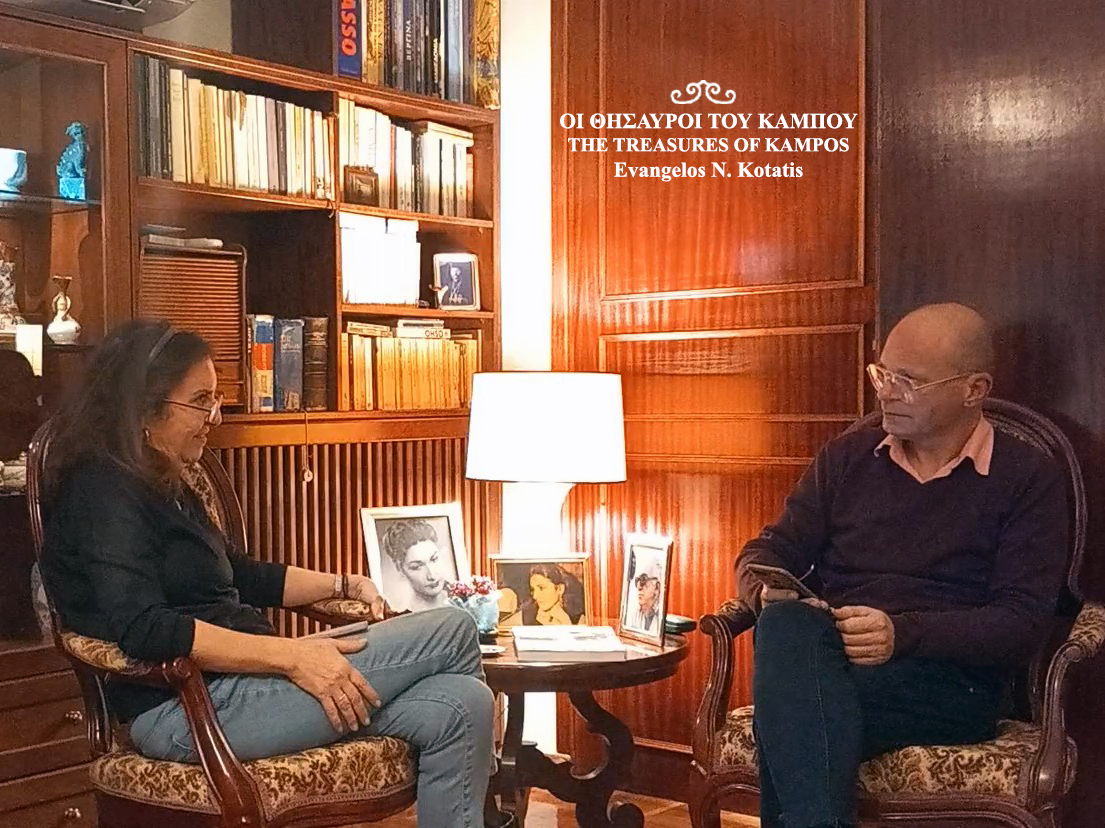
In Kampos, Chios, a place where time flows continuously through people and ideas, I had the honor of conducting an interview in Athens with Ms. Lia Forou – Karavas, a descendant of the historic Karavas family. Although the interview took place in the capital, Ms. Forou – Karavas frequently visits the family estate in Kampos and is the last descendant maintaining its living memory and connection to this space, which has for generations been a place of life, education, and intellectual creation.
The Karavas family is deeply connected to the intellectual history of Chios and Greece: from Argyrios Karavas (1810–1870), philologist, editor, and headmaster, whose works document the region – including the “Topography of Chios,” to Epameinondas Karavas (1838–1911), supervisor of Public Education, and the poet Aristidis Karavas (1884–1942). Their works are preserved today at the Hellenic Literary and Historical Archive of the National Bank Cultural Foundation (ELIA–MIET) and at the Public Central Historical Library of Chios “Korais,” including important historical records such as the Massacre of Chios (1822).
The Karavas family archive includes manuscripts of Argyrios Karavas verse and prose works, a bound volume of six issues of the “Philological Garden of Ionia” (1838) published by the Karavas and I. Skylitsis, his correspondence and personal documents (1845–1870), as well as the correspondence and personal papers of Epameinondas A. Karavas, Platon E. Karavas (financier), and the poet Aristidis E. Karavas, including unpublished and published poems and articles about his work and death (1919–1951).
At this hospitable estate, an intellectual circle was formed that guided the steps of scholars and men of letters such as Drosinis, Porfyras, Nirvanas, Ouranis, and others. This intellectual tradition continued into the 20th century through circles of thought connected to figures of the modern Greek and European spirit, including the philosopher and thinker Kostas Axelos, first husband of Rea Karavas, and her second husband, Claude Simon, French writer and Nobel laureate (1985), confirming that the Karavas family was not only a custodian of memory but an active participant in contemporary intellectual history.
The same estate has even deeper roots, as it is connected to the family’s ancestor, the great benefactor Andreas Syngros, reminding us of the timeless relationship of the place with culture and education. Andreas Syngros (1830–1899) was one of the most important figures of modern Greek history, a national benefactor, banker, and politician, with decisive contribution to the economic, social, and intellectual development of the Greek state.
The photograph of the garden at the estate comes from my personal collection (2015). The old black-and-white photograph of the family at the estate (from right to left: Aristeidis Karavas, Eleftheria Karavas, Platon Karavas and Socrates Karavas) and the photographs of Andreas Syngros, together with the ‘Lyra of Solitude’ and the poem ‘Jasmines’ by Aristides Karavas, were kindly provided by Lia Forou – Karavas during the interview. Snapshots from our meeting, along with my book The Treasures of Kampos, engage in a dialogue with the past and capture the continuity of memory.
The estate continues this tradition today, hosting cultural events, exhibitions, and activities.